economics.fundamentalfinance.com Negative Externality
Negative ExternalityA negative externality occurs when an individual or firm making a decision does not have to pay the full cost of the decision. If a good has a negative externality, then the cost to society is greater than the cost consumer is paying for it. Since consumers make a decision based on where their marginal cost equals their marginal benefit, and since they don't take into account the cost of the negative externality, negative externalities result in market inefficiencies unless proper action is taken. When a negative externality exists in an unregulated market, producers don't take responsibility for external costs that exist--these are passed on to society. Thus producers have lower marginal costs than they would otherwise have and the supply curve is effectively shifted down (to the right) of the supply curve that society faces. Because the supply curve is increased, more of the product is bought than the efficient amount--that is, too much of the product is produced and sold. Since marginal benefit is not equal to marginal cost, a deadweight welfare loss results.
A common example of a negative externality is pollution. For example, a steel producing firm might pump pollutants into the air. While the firm has to pay for electricity, materials, etc., the individuals living around the factory will pay for the pollution since it will cause them to have higher medical expenses, poorer quality of life, reduced aestetic appeal of the air, etc. Thus the production of steel by the firm has a negative cost to the people surrounding the factory--a cost that the steel firm doesn't have to pay. There are still many other examples of negative externalities. These can include decisions that result in costs to other individuals: sitting on the end of a row so that others have to climb over you, littering, painting your house an ugly color in a nice neighborhood, not showering, cutting in line, etc. Solving the Negative Externality Problem
Negative externalities are a property rights problem. Who owns the air that the steel mill pollutes? Ronald Coase put forth the solution which is known as the Coase Theorem:
Another way to solve the negative externality problem is to simply tax the producer the amount of the negative externality. This adds to the producers marginal cost and will cause them to reduce output. The video below discusses how taxes can discourage certain behavior. |
|||
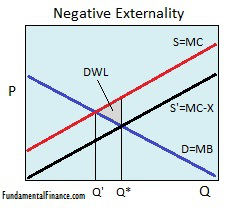 This graph shows the effect of a negative externality. The red line represents society's supply curve/marginal cost curve while the black line represents the marginal cost curve that the firm or industry with the negative externality faces. The optimal production quantity is Q', but the negative externality results in production of Q*. The deadweight welfare loss is shown in gray.